Beyond milk and bread – the engineering perspective of winter storms
With a winter storm predicted for this weekend, many head to the store to shore up their cupboard and supplies. Engineering professionals do the same, but they also have added layers of considerations and advice. Two of Charlotte’s Niner Engineers shared what is on their minds this weekend, ahead of the storm.

Jim Gafford, associate director of applied research at the Energy Production and Infrastructure Center, provides insight on power outages.

Stephanie Pilkington, assistant professor of civil engineering technology and construction management adds meteorological considerations.
What happens
JG: There are differences between snow storms, winter storms and ice storms. Each of these impact our infrastructure differently. A heavy snowfall is actually the least impactful. Ice storms on the other hand, particularly freezing rain, are highly problematic.
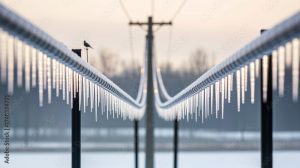
Ice storms cause ice glazing on roadways, power lines, trees and vegetation. A thin coating of ice over a long power line span imparts significant weight that can exceed the tensile strength of the conductors causing them to fail. Similarly, the additional weight to trees and vegetation can result in large limbs or other heavy objects to fall onto power lines also resulting in faults and failures.
SP: Over the past few days we’ve seen meteorologists discuss the different models and what may happen, specifically whether we will see snow, sleet, freezing rain, and/or rain. Part of this involves looking at the “rain-snow line” which is dictated primarily by the thickness of the atmosphere above us (low thickness = colder temperatures).
Those north of the line will receive the more manageable snow, while south of the line trends toward sleet and freezing rain. As we have moved closer to the weekend, that line has moved northward, putting Charlotte more into the ice/wintry mix area, which translates to a higher impact ice storm.
Do this
JG: Stay calm and be patient.
In a storm, like that which is forecasted for our region this weekend, significant strain is placed on utility crews tasked with restoring service. Utilities will dispatch crews accordingly to restore power for critical infrastructure first and coordinate crews to work in a manner that most efficiently restores power to as many customers as quickly as possible.
Avoid downed power lines – they are exceptionally dangerous.
Always assume a downed line is live, and do not drive over a downed line (your rubber tires are not insulating).
In the unlikely event that a power line falls on your vehicle with you inside, the car body itself is your best protection.
Stay inside the vehicle and call for help. Only exit if there is an immediate fire, and do so by jumping clear without touching the car and the ground at the same time.
Inside your home, it may be wise to unplug sensitive electronic devices.
As power is restored it is possible that power surges occur which can cause damage.
SP: If you must venture out, use snow tires if you have them.
Drive in the snowy tire paths – it gives you more traction. And take extra precaution crossing bridges. Since bridges are open air underneath, and air cools faster than the ground does, ice is most likely to form on bridges first.
For your home, if you lose heat and power, check your roof for any ice buildup after the storm passes.
This will likely occur in or near gutters, resulting in ice dams that put extra loading on your roof. According to 2010 building codes, most homes built since then can likely withstand the amount of ice currently being forecasted.
not that
JG: If you have a stand alone electric power generator, do not connect this to the main power circuit to your home.
This includes attempting to plug a generator into a home outlet. Without a professionally installed and properly operated power transfer switch, your generator will backfeed electricity to the grid. Transformers that reduce the voltage used in your home from the high voltage grid work in both directions. Connecting generators to your home can easily result in thousands of volts on downed power lines that our line crews are working to restore, placing them at grave risk.
If you are operating a gas generator, never run these in enclosed spaces, including garages
Keep exhaust away from open windows. Carbon monoxide poisoning is a serious risk as well.
Don’t take it personally: your power and that of your neighbor may not be restored at the same time.
You may be on different feeder circuits, so they would need to be repaired independently. If you see neighbors across your street with lights on while yours are still out, that is not out of the ordinary and the power company isn’t intentionally leaving you in the dark.
SP: Stay off the roads as much as you can, since ice is not always visible on roads like snow.
Four wheel or all wheel drive will not be as helpful and will not keep a vehicle from skidding off the road.
JG: Further, in the event of a widespread outage, staying off of the roadways keeps line crews and other essential workers safer and gives them space to work faster for you.