Lab Hazard Assessments
Laboratory Hazard Assessment Signs are intended to provide rapid hazard awareness for individuals entering laboratory and engineering spaces within the William States Lee College of Engineering. These signs serve several administrative and emergency purposes, including:
- Providing responsible party contact information
- Listing hazards that may affect maintenance or emergency response
- Provide a quick-access QR code to other critical safety information
These signs are not intended to list every hazard that may exist within a given space. Nor are they a replacement for laboratory-specific training.
All laboratory and engineering spaces are access-restricted. All faculty, staff, and students must receive permission to enter a given lab from that lab’s PI or the Research Operations Manager/Lab Manager.
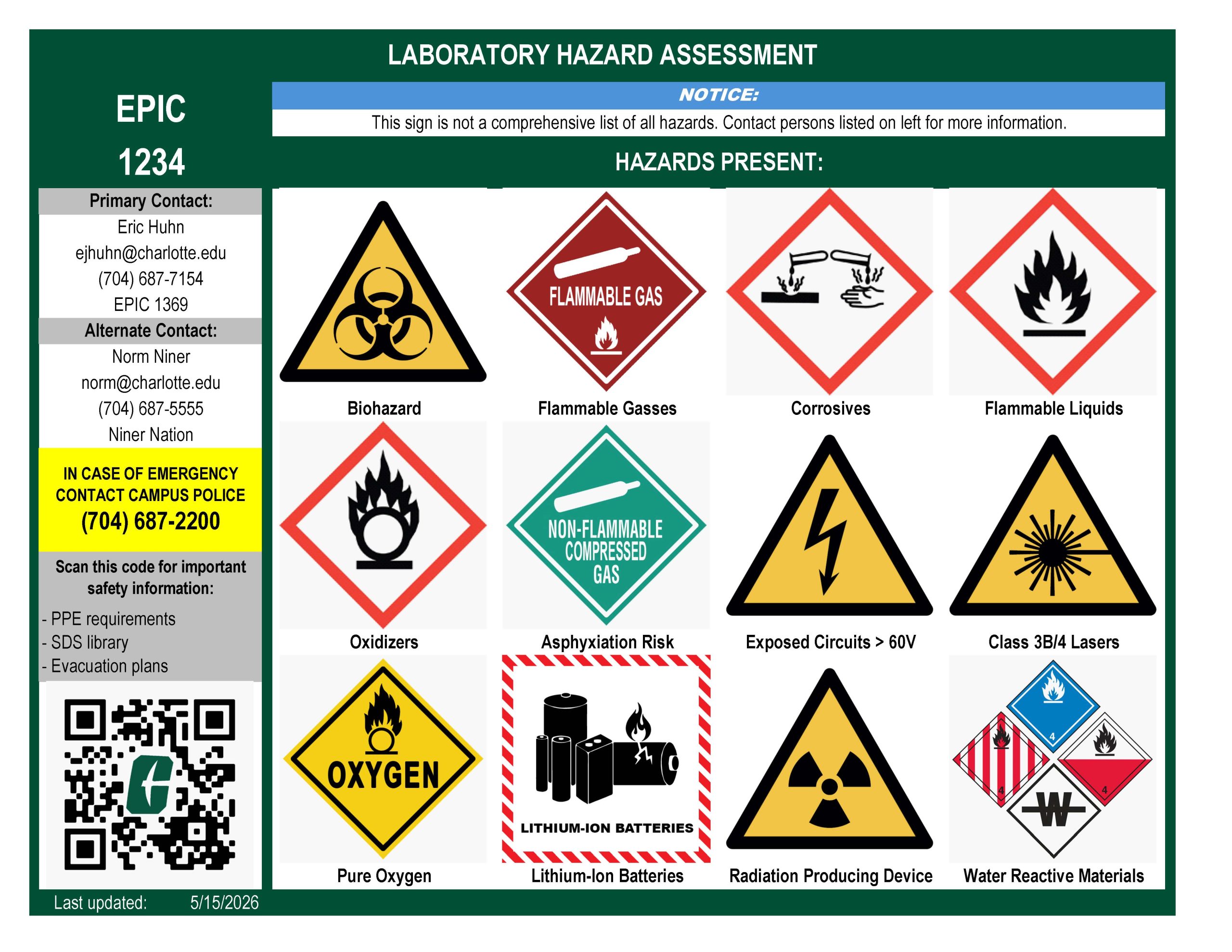
Below is a guide for all hazard pictograms that may be shown on a lab hazard sign.

Non-Hazardous Area: This icon indicates that during the hazard assessment no hazardous activities or materials were noted. This sign should not be interpreted to mean that it is impossible to be injured in a space. NO SPACE IS PERFECTLY SAFE.

Compressed Inert Gas: Wherever compressed, bottled air, nitrogen, argon, or other intert gas is present. Refer to the University’s Compressed Gas fact sheet.
In case of an equipment failure, an oxygen deficient atmosphere may be created.

Flammable Gas: Compressed, flammable gasses are present. Refer to the University’s Compressed Gas fact sheet.
In case of an equipment failure, an explosive atmosphere may be created.

Oxygen: Pure oxygen is in-use or being stored. Refer to the University’s Compressed Gas fact sheet.
In case of an equipment failure, an oxygen-rich atmosphere may be created.

Corrosives: Any space where strong acids or bases are used or stored. Must be enrolled in University’s Chemical Hygiene Plan.
Unknown spilled liquids must be identified prior to cleaning to prevent accidental reactions.

Flammable Liquids: Flammable liquids, or solvents are stored or used.
Unknown spilled liquids must be identified prior to cleaning to prevent accidental reactions.

Oxidizer: Any chemical, other than pure oxygen, that is classified as an oxidizer.
Unknown spilled liquids must be identified prior to cleaning to prevent accidental reactions.

Biohazard: Any space handling biologic material that is subject to the University biosafety program (University policy 714). A BSL lab sign, provided by the University’s biosafety office, must accompany the COE’s lab door sign.

Live Circuits: Manipulation of live electrical circuits at 60 Volts or greater may be occurring.
Treat any exposed conductor as live unless confirmed deenergized with a multimeter.

Laser: Class 3b or 4 laser may be in use. Subject to the University’s Laser Safety Program. A laser safety sign, provided by the University Laser Safety Officer, must accompany the Lab Hazard Assessment door sign.
Injury could result if persons unknowingly walk into the path of a laser.

Radiation Production: Any space where ionizing radiation is produced, or radioactive materials are handled or stored. A radiation safety sign, provided by the University’s Radiation Safety Officer, must accompany the Lab Hazard Assessment door sign. Refer to the University’s Handbook for Radiation Safety.

Lithium-Ion Batteries: 250 Ah, or greater, worth of lithium-ion batteries are in use or being stored.

Reactive Solid: Materials are in use that could be unstable if they come in contact with water.
Report any water leaks affecting the space immediately! In case of fire do not use water!