Parkhideh receives NCInnovation award to advance energy resilience technology

Babak Parkhideh develops technology that will improve North Carolina’s infrastructure efficiency, and can now test and apply his research in the real world with a new grant from NCInnovation.
Parkhideh, associate professor of electrical and computer engineering in the William States Lee College of Engineering, received $787,474 from NCInnovation to advance his research on sensor technology designed to identify potential issues with electrical systems and power supplies.
He and his team, including Co-PI Jim Gafford, associate director of applied research at the Energy Production and Infrastructure Center, are developing highly advanced sensors that predict equipment failure before it disrupts operations. The technology analyzes electrical signals and system behavior to identify early warning signs that are often undetectable through manual inspection.
The sensors are designed for use across several sectors:
- Industrial manufacturing, reducing downtime by identifying unseen issues
- Power grid, reducing large-scale outages through proactive maintenance
- Other energy sources, optimizing the performance of renewable energy systems
“Dr. Parkhideh’s research really shows the caliber of work consistent with our engineering faculty,” said Brigid Mullany, associate dean for research in the college. “Being recognized by the NCInnovation award exemplifies the top tier research happening at UNC Charlotte overall.”

The technology allows manufacturing and utility operations to shift from reactive repairs to predictive maintenance, increasing strategic operations, reducing overhead costs and avoiding unexpected delays. Ultimately, Parkhideh’s research will strengthen infrastructure resilience across North Carolina.
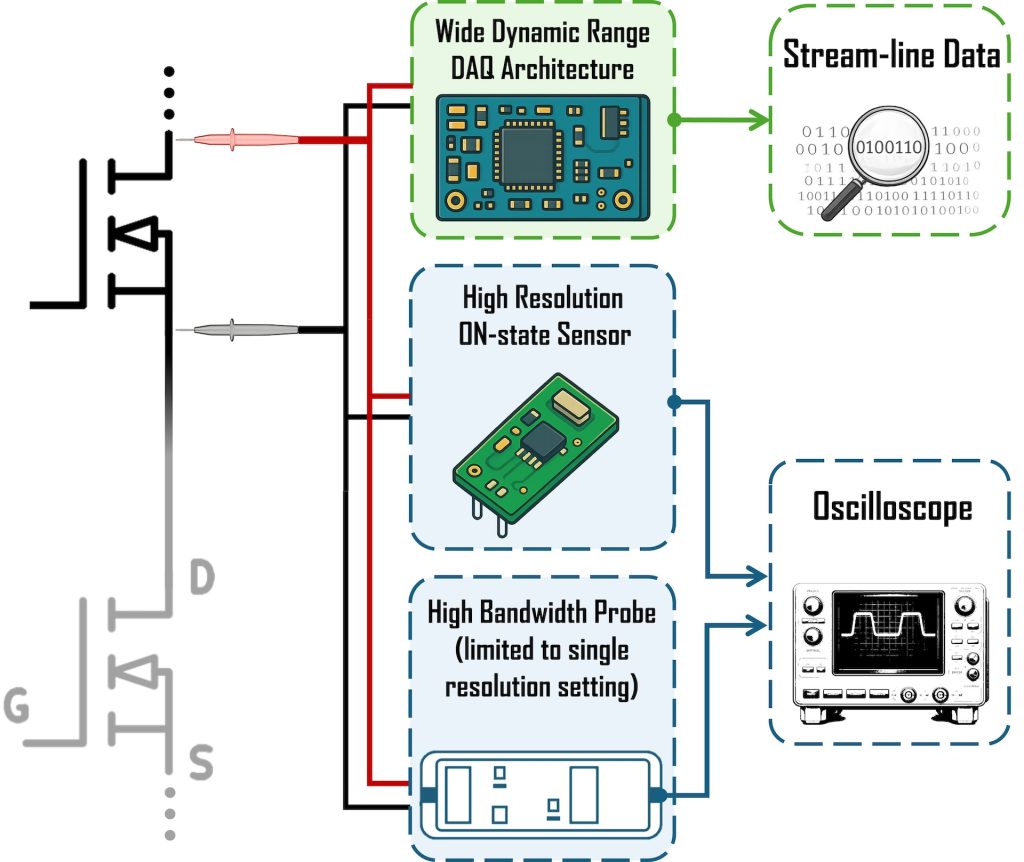
Technical context: figure displays merging of an embedded Data Acquisition System (DAQ) with advanced electrical sensing for power electronic devices with high bandwidth metrology (High Bandwidth Probe + Oscilloscope). The combination allows for accelerating the throughput of emerging power systems devices in a production setting by improving quality assurance and reliability testing while reducing the number of individualized test procedures. This reduces manufacturing costs while improving quality control through the assessment of reliability metrics holistically. Simultaneously, high bandwidth data capture allows for higher resolution performance analysis of statistically significant samples.
The NCInnovation funding will support Parkhideh’s team as they transition the technology from the laboratory to real-world testing and commercialization, helping position the state as a leader in advanced energy reliability and grid modernization. Learn more about NCInnovation grants.