School of Energy Research
By combining scientific discovery, innovation, multidisciplinary collaboration and industry and community engagement, our research program aims to create a vibrant research ecosystem that contributes to both scientific discovery and the practical advancement of technology and knowledge in the broader community.
Our multidisciplinary research team is formed to address complex challenges from multiple perspectives, including engineering, technology, science, business and social sciences. We actively engage industry partners and communities for real-world insights, technology transfer, entrepreneurial ventures and training. Our research prioritizes cross-cutting research themes that align with global challenges and industry needs, from renewable energy and smart cities to workforce training and sustainable economic growth.
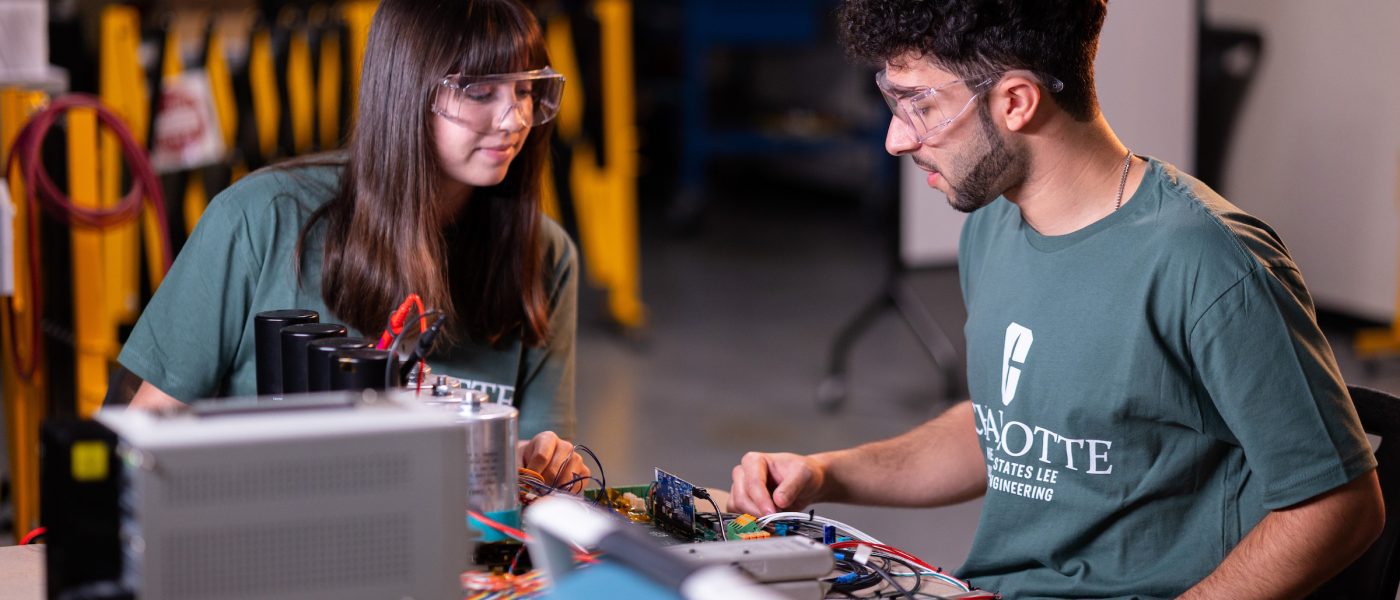
Energy Production and Infrastructure Center (EPIC)
- Grid Modernization Research
Advanced Manufacturing and Security
- Applied electro-mechanical systems
- Robotics, automation, control, and security systems
- Biomechanics and applications in medical and health

Data and Digital Transformation
- Data analytics and AI applications
- Information modeling, remote sensing, and cloud computing applications
- Virtual and augmented reality applications
Energy Transition and Sustainability
- Energy generation, harvesting, and modeling
- Energy transition, marine energy, solar and photovoltaic (PV) system
- Green infrastructure and sustainable materials
Infrastructure System and Resilience
- Smart cities
- Socio-infrastructure system
- Community resilience
Research Laboratories
Cyber-Physical Emulation Range (CyPhER) Lab
The Cyber-Physical Emulation Range (CyPhER) Lab focuses on cybersecurity research for government agencies.
Faculty Contact: Dr. Aidan Browne
Location: 321 Smith
Fluids, Ultrasonics, Sensors & Electromechanics (FUSE) Lab
The FUSE Lab integrates fluid mechanics, microfluidics, magnetics, and electromechanics to make complex three-dimensional flows measurable and controllable. The lab develops high-fidelity volumetric diagnostics (e.g., tomographic and light-field PIV, optical-flow methods), engineers broadband soft-matter transducers (e.g., PVDF-TrFE, IPMCs, dielectric elastomers) with physics-based calibration, and designs magnetic fields, coils, and power electronics for actuation, alignment, and sensing. Research includes hybrid magnetic–acoustic additive manufacturing, magneto-active materials, and sensorized biomedical microfluidic platforms for biofluids, acoustofluidic and magnetofluidic transport, and flow–structure interaction. A systems-level perspective spans embedded control, GPU computing, and validated models. Deliverables include open datasets, reproducible algorithms, and reference hardware to enable AI-assisted modeling, cyber-manufacturing, and resilient low size–weight–and–power (SWaP) sensing and actuation across aerospace, biomedical systems, and advanced manufacturing. The lab trains graduate researchers through hands-on, open workflows and collaborations with industry and government partners.
FUSE (Fluids, Ultrasonics, Sensors & Electromechanics) Lab
Faculty Contact: Dr. Rodward L. Hewlin, Jr.
Location: 105 Smith
Laboratory for Instrumentation, Sensors and Power Electronics (LISPEL)
The Laboratory for Instrumentation, Sensors, and Power Electronics (LISPEL) supports a broad range of capabilities for the design, fabrication, and testing of electronic circuits, with emphasis on sensors and power electronics. The lab also supports the development of high-voltage applications and is currently used for studies of the electrical properties of dielectric materials under controlled environmental conditions, analysis of acoustic and electromagnetic signal fusion, and development of energy-harvesting circuit topologies.
Laboratory for Instrumentation, Sensors and Power Electronics (LISPEL)
Faculty Contact: Dr. Maciej Noras
Location: 353 Smith
Mechatronic and Robotic Systems (MARS) Lab
The Mechatronic and Robotic Systems (MARS) Lab focuses on research with a variety of electromechanical systems. The lab is the home to numerous industrial robots, ground vehicles, aerial vehicles, and associated support equipment.
Faculty Contact: Dr. Aidan Browne
Location: 302 Smith
Modeling, Instrumentation, Dynamic Systems, and Controls (MIDAS) Lab
The Modeling, Instrumentation, Dynamic Systems, and Controls (MIDAS) Lab focuses on research in: (a) monitoring, instrumentation,= and sensors (e.g., development of advanced sensors and process monitoring); (b) process modeling and data analytics (e.g., physics-based and data-driven methods, including machine learning–based models); and (c) control systems (e.g., nonlinear and adaptive controls) and device development (e.g., components and mechanisms). Key application areas include energy systems, electromechanical systems, manufacturing processes, and devices. Senior personnel include Dr. Michael Smith and Dr. Rodward Hewlin, Jr.
Modeling, Instrumentation, Dynamic systems, and controlS (MIDAS) Lab
Faculty Contact: Dr. Michael Smith
Location: 105 Smith
Renewable Energy Mechanisms (REM) Lab
The Renewable Energy Mechanisms (REM) Lab focuses on the design, simulation, prototyping, and testing of mechanisms that support renewable energy systems. Research activities have addressed wind, wave, and tidal energy systems, as well as solar thermal concepts and human-powered generators.
REM Renewable Energy Mechanisms Lab
Faculty Contact: Dr. Wesley Williams
Location: 304B Smith
Robotic Accelerated Catalysis & Entropy Research (RACER) Lab
The Robotic Accelerated Catalysis & Entropy Research (RACER) Lab is an interdisciplinary research group operating at the intersection of artificial intelligence, advanced manufacturing, and robotics. The lab applies machine learning to accelerate materials discovery, leverages ultrafast laser and flash Joule heating techniques for scalable fabrication, and develops autonomous platforms that transform traditional trial-and-error workflows into self-driving laboratories. The lab’s mission is to bridge fundamental research with real-world applications in energy, electronics, and sustainable technologies.
Robotic Accelerated Catalysis & Entropy Research (RACER Lab)
Faculty Contact: Dr. Sheldon Xie
Location: 104 Smith