Faculty
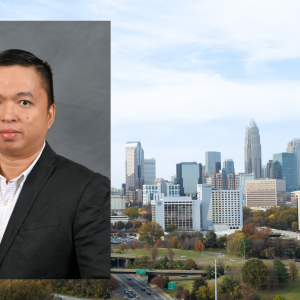
Engineering faculty member Chau Le recognized nationally for research and academic service
The newly launched Albert School of Construction at UNC Charlotte is already making waves on the national stage. At the recent ASCE Construction Institute and Construction Research Congress 2026 Joint Conference in San Antonio, Texas, Chau Le, assistant professor in engineering technology and construction management, earned multiple prestigious honors for his research and academic service.
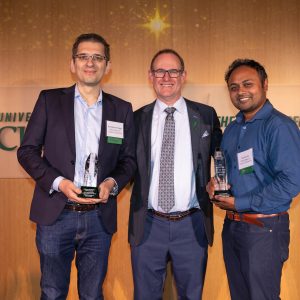
Engineering faculty presented top University awards for innovation
William States Lee College of Engineering was in the spotlight during UNC Charlotte’s 2026 Invention of the Year Awards, an evening that showcased the university’s growing role as a national engine of innovation, commercialization and technological impact. Engineering innovators took home the grand prize, called the “Excellence Award,” as well as the Physical and Material Sciences category award.
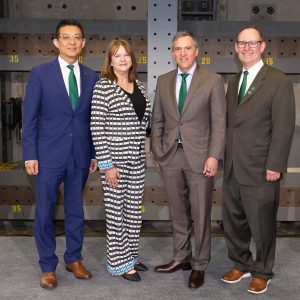
Building the future: Lingguang Song appointed founding director of the newly launched Albert School of Construction
As the construction industry faces a critical evolution toward automation, it also enters a significant workforce shortage. To help solve these challenges, Rob Keynton, dean of the William States Lee College of Engineering, has appointed Lingguang Song as the founding director of the newly launched Albert School of Construction. A leader in integrating technology, Song is tasked with bridging the workforce gap and preparing the next generation of engineers to modernize the built environment.
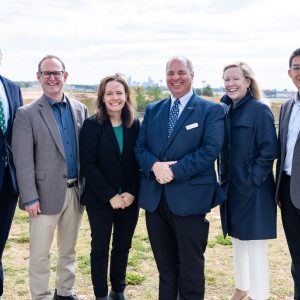
First-of-its-kind partnership and research project to improve runways across the nation
UNC Charlotte’s Aviation and Innovation Research Institute and Charlotte Douglas International Airport have launched a joint research program — the only one of its kind in the nation — embedding high-sensitivity sensors directly into the concrete of a runway as it’s being poured. Led by Tara Cavalline, director of the Charlotte AIR Institute and professor in the William States Lee College of Engineering, the groundbreaking collaboration will capture real-time data on how pavement responds to weather, temperature shifts, and the constant impact of aircraft landings and takeoffs.
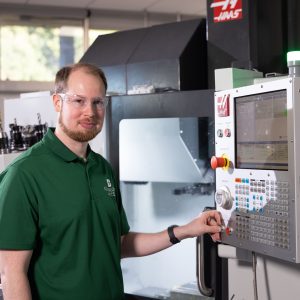
America’s first public university Super Fab Lab
During COVID-19, Associate Teaching Professor Terence Fagan demonstrated the power of “democratized innovation” by producing clear face masks for medical workers. This sparked his interest in the Fab Foundation’s Super Fab Labs. While standard Fab Labs focus on small-scale prototyping, SFLs provide expanded capabilities for industrial R&D and “concept-to-production” workflows. At the time, only five existed globally.
Following years of strategic planning with Rob Keynton, dean of the William States Lee College of Engineering, Fagan’s vision for a Charlotte SFL materialized. Keynton secured funding via Engineering North Carolina’s Future, a 2022 General Assembly initiative. Fagan enhanced the SFL model by integrating a specialty focus on advanced manufacturing, effectively bridging the gap between initial prototyping and full-scale production.
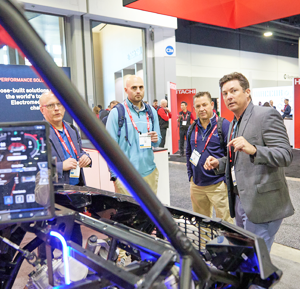
Niners are invited to The Battery Show South
UNC Charlotte’s BATT CAVE invites all Niner Engineers to The Battery Show South 2026, which will be held on April 22–23 at the Charlotte Convention Center. This two-day event brings together engineers, researchers and industry leaders across the battery, electric vehicle and energy storage sectors. Attendees will find a valuable opportunity to explore cutting-edge technologies, attend technical sessions and engage in high-impact networking.

Mobility and the air we breathe: transportation emissions and chronic disease
Carlos Gonzalez-Calderon, assistant professor of civil and environmental engineering, has been named a 2026 Gambrell Faculty Fellow. With support from The Gambrell Foundation and as part of the Charlotte Urban Institute’s Gambrell Faculty Fellowship, he will join nine other UNC Charlotte faculty as they leverage the scholarship to help develop a better quality of life for Charlotte.

Stuart Smith elected National Academy of Inventors Fellow
Elevating UNC Charlotte’s standing in advanced research, Professor of Mechanical Engineering Stuart Smith has been elected a Fellow of the National Academy of Inventors, a status nationally recognized as the highest professional distinction awarded to inventors. This honor places Smith among an esteemed group of pioneers recognized for creating outstanding inventions that make a tangible impact on quality of life, economic development and the welfare of society.

UNC Charlotte’s Grid Innovation Earns NSF Engines Finalist Recognition
When the National Science Foundation named UNC Charlotte as a finalist in its Regional Innovation Engines program, it marked a significant milestone for the university’s emergence as a national hub for energy innovation. Central to this success is Grid Ancillary services with Uninterruptible Power Supply (GAUPS) technology, developed by Sukumar Kamalasadan, the Duke Energy Distinguished Professor in Engineering in UNC Charlotte’s William States Lee College of Engineering. GAUPS addresses a critical challenge facing advanced manufacturers, hospitals, and data centers across the Carolinas: costly power quality disruptions.
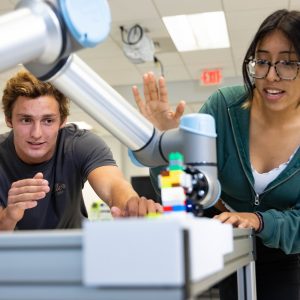
Engineering North Carolina’s Future is driving tech, energy and innovation at UNC Charlotte
Highly skilled Niner Engineers are key to North Carolina’s continued rise in technology, energy and advanced manufacturing. Support for their education comes from Engineering North Carolina’s Future, an initiative backed by a $41.2 million investment in the University by the North Carolina General Assembly.
The investment, beginning in fall 2022 to the current fall semester, has yielded record-breaking student enrollment at the W.S. Lee College of Engineering and other significant advances.